

- Details
- Pan-Australia Kilometre-Scale Weather and Climate Modelling: Bridging the Tropics and Midlatitudes - 19 November 2024, 21:00-22:00 UTC. Register here. (Digital Earths Webinar series)
- The LIAISE Land Surface Model Inter-comparison: What Goes Wrong When These Models Are Run at km-Scale Resolutions? - 2 December 2024, 15:00 UTC. Register here for this webinar (Digital Earths webinar series on high-resolution land model and land-atmosphere coupling)
- Details
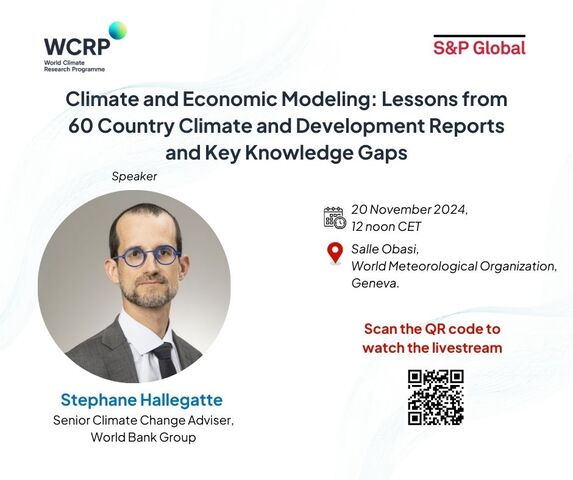
Stéphane Hallegatte, Senior Climate Change Adviser at the World Bank Group, will be at the World Meteorological Organization to deliver a keynote on Climate and Economic Modeling: Lessons from 60 Country Climate and Development Reports and Key Knowledge Gaps.
In his lecture, he will draw from his experience at the World Bank to highlight what works and what doesn't, in the climate and economic modeling realm. This lecture is part of a series of workshops (invite-only, in-person) organized by the World Climate Research Programme (WCRP) and S&P Global.
Scan the QR code in the image to join the livestream.
- Details
- Details
5 November 2024, 15:00-16:30 CET
Join us for the next webinar in the Tipping Points Discussion Series, which will explore the origins of model uncertainties and shift the focus from asking when a model is "good enough" to considering when it becomes too unrealistic to be useful. The webinar will include two talks by Dave Stainforth (London School of Economics) and Thomas Stocker (University of Bern) and will be moderated by Gabi Hegerl (University of Edinburgh). Register now!
- Details
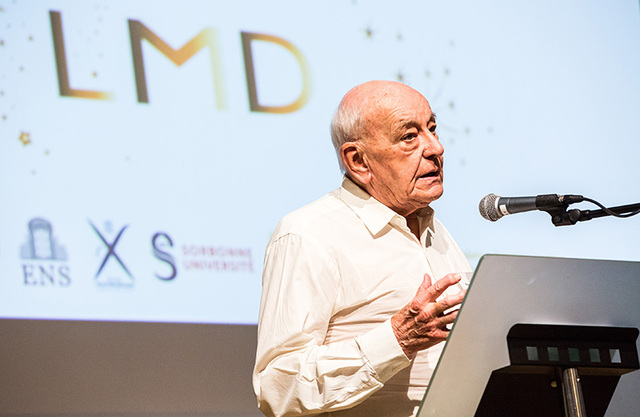
It is with sadness that we announce the passing away of Dr Pierre Morel. Pierre, as well as a distinguished scientist in his own right, was the first Director of WCRP as well as a founding member of WCRP's GEWEX Core Project.
- Details
We are delighted to announce the next webinar hosted by the Explaining and Predicting Earth System Change (EPESC) lighthouse activity on 12 November 2024. The details are as follows:
- Topic: Approaches, Challenges, and Emerging Opportunities in Extreme Event Attribution
- Date and time: 12 November 2024; 12:00 CEST.
- Speakers: Dr Nicholas Leach (University of Oxford), Dr Yukiko Imada (University of Tokyo), Dr Yang Chen (Chinese Academy of Meteorological Science).
To register for this webinar, click here.
Past webinars of the EPESC webinar series, are available here.
- Details
**The deadline for proposals has been extended until 31 March 2025**
The World Climate Research Programme (WCRP) is delighted to open a call for proposals to host a dedicated project office in support of one of WCRP’s core activities: the COordinated Regional climate Downscaling EXperiment (CORDEX).
CORDEX is the focal point for advancing and coordinating the science and application of regional climate downscaling through global partnerships within WCRP. This fosters and grows research focused on advancing and coordinating the science and application of regional climate downscaling, to effectively link global climate research and the regional information needs of society. In its 15-year (2009-2024) history, CORDEX’s activities have generated a wealth of cutting-edge research. CORDEX has a major role in in key international scientific assessment reports, including WMO Global Framework for Climate Services, and the United Nations Framework Convention on Climate Change (UNFCCC) Intergovernmental Panel on Climate Change (IPCC), by providing climate projections at the regional and local scale and through increasing science capacity in the Global South.
The Host Institution will significantly benefit from hosting the CORDEX IPO by having a close interaction with this critical domain of research in support of regional downscaling experiments. It will serve as a great opportunity for the host to help deliver the exciting new goals of CORDEX to the international community.
- Download the open call application package
- The deadline for proposals has been extended until 31 March 2025
All communications and enquiries regarding this call should be directed in English to Maureen Wanzala (
- Details
Our planet is witnessing cascading and damaging effects due to surges in temperature driven primarily by anthropogenic climate change, reveals the latest 10 New Insights in Climate Science (10NICS) report. These impacts have ripple effects on maternal and reproductive health and on one of our most vital natural carbon sinks, the Amazon rainforest, to name a few.
Launched on Monday 28 October 2024 by a consortium of globally renowned social, natural and climate scientists, the 10NICS report spans a vast range of climate research and is designed to equip policymakers with the latest and most pivotal climate research published over the past 18 months. The The latest research on the insight topics is synthesised to highlight the policy implications that can inform negotiations at COP29 and policy through 2025 and beyond.
Read the full press release here.
Read the 10NICS report here.
- Details

The International Polar Year 2032-2033 Updated Concept Note along with the IPY timeline graph, was released and is now available for download here.
For more information and to provide feedback please contact the IPY Secretariat at
- Details
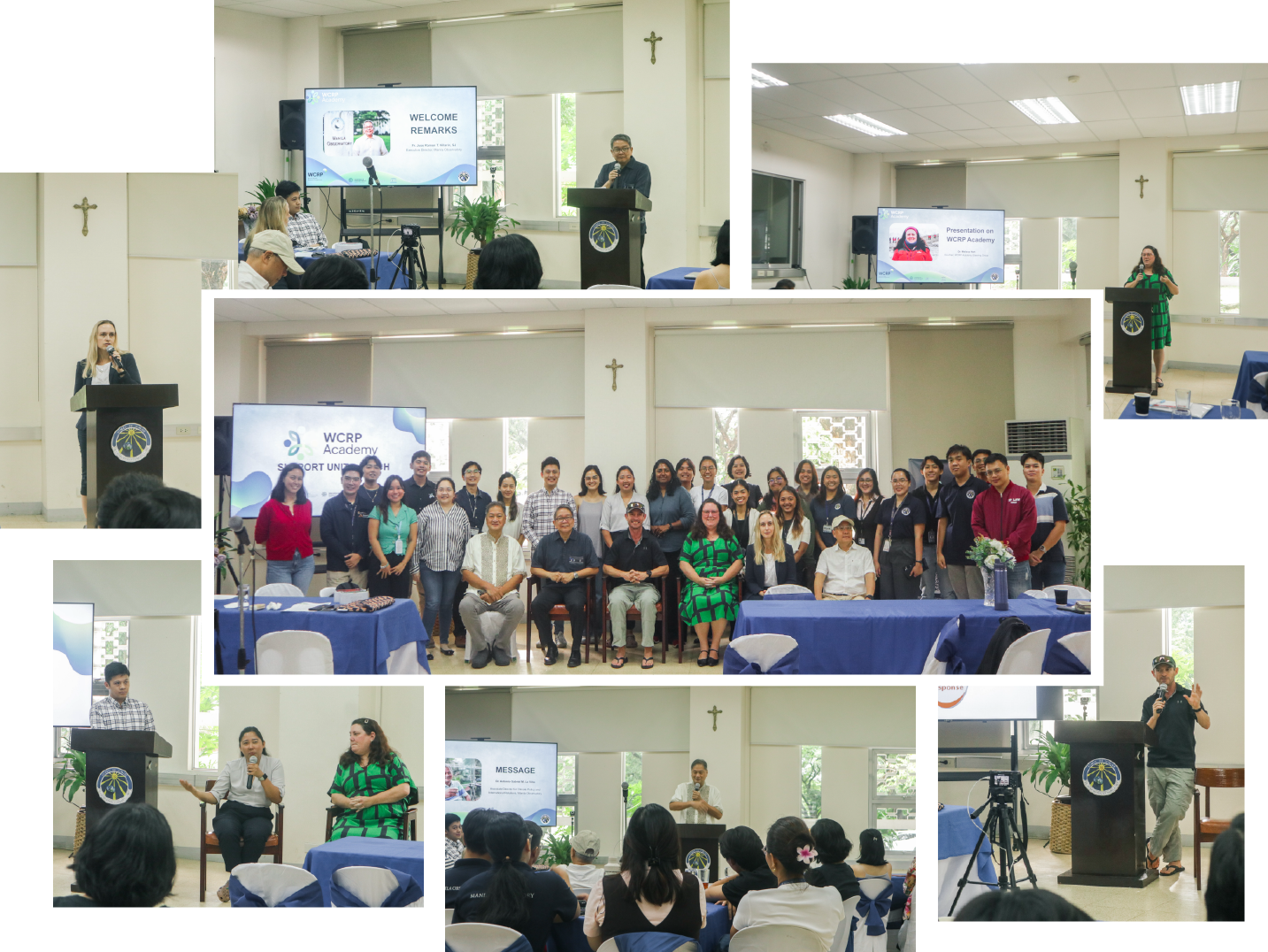
The WCRP Academy Support Unit was officially launched at the Manila Observatory on 7 October 2024, making history as the first of its kind within the Programnme and the first WCRP support office located in the Global South. To read more, click the heading above.
- Details
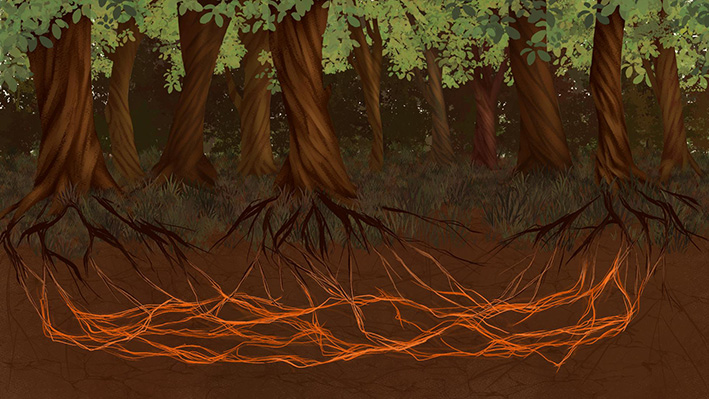
The Argentina CONICET Hub of My Climate Risk (WCRP) invites you to the webinar "Climate storylines as a tool for interdisciplinary dialogue on risk decision-making" on Wednesday 23 October 11:00-12:00 Argentina / 14:00-15:00 UTC.
- Details
The WCRP Working Group on Subseasonal to Interdecadal Prediction (WGSIP) is seeking global experts dedicated to advancing the science, practice, and application of Earth System prediction over these timescales. In addition to improving understanding of the physical processes that influence prediction accuracy, the group focuses on enhancing model setup, forecast diagnostics, and methods for making predictions from weeks to decades.
Applications must be submitted by completing this application form. The deadline to submit applications is October 31, 2024,
For more information, please refer to the full open call or contact
- Details
The WCRP Regional Information for Society (RIfS) Core Project invites the community to nominate candidates (including self-nomination) who are based in countries not currently represented by the Scientific Steering Group (SSG) and particularly encourages applications from Asia, "Least Developed Countries", "Landlocked Developing Countries", and "Small Island Developing States", to joint the RIfS SSG.
Please read the information about the call carefully before nominating. This is a limited call to fill two openings, with terms to commence at the start of 2025. Application deadline is: 12:00 UTC on Thursday 31 October 2024.
- To know more and to apply, click here.
- Details

The WCRP Climate and Cryosphere (CliC) Scientific Steering Group recently approved a new Working Group: Impacts of changes in the mountain cryosphere (IC-MontC). We are now seeking nominations (including self-nomination) to the IC-MontC Steering Group(SG), which will develop and execute its implementation plan for the initial 5 years.
Deadline for applications and nominations: 31st October 2024
- To know more and to apply, click here.
- Details
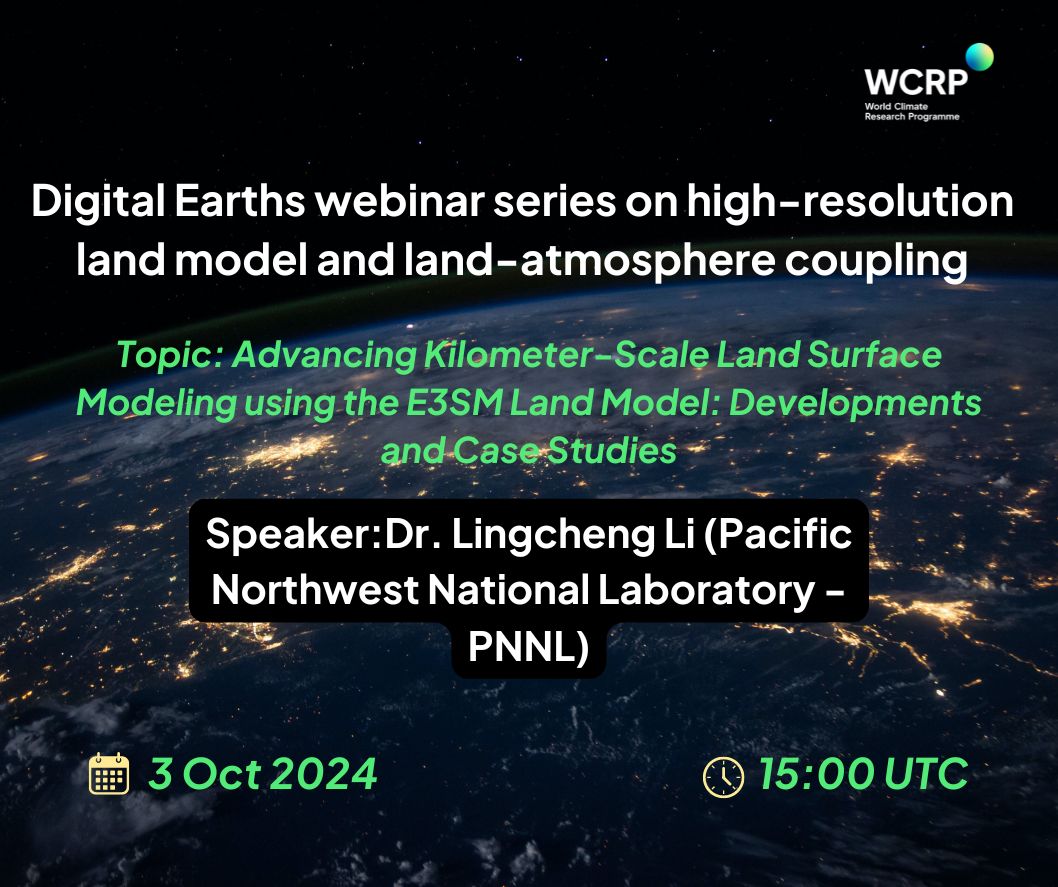
We are delighted to invite you to a webinar on "Advancing Kilometer-Scale Land Surface Modeling using the E3SM Land Model: Developments and Case Studies" as part of the Digital Earths webinar series on 03 October 2024, 15:00 UTC.
- Details
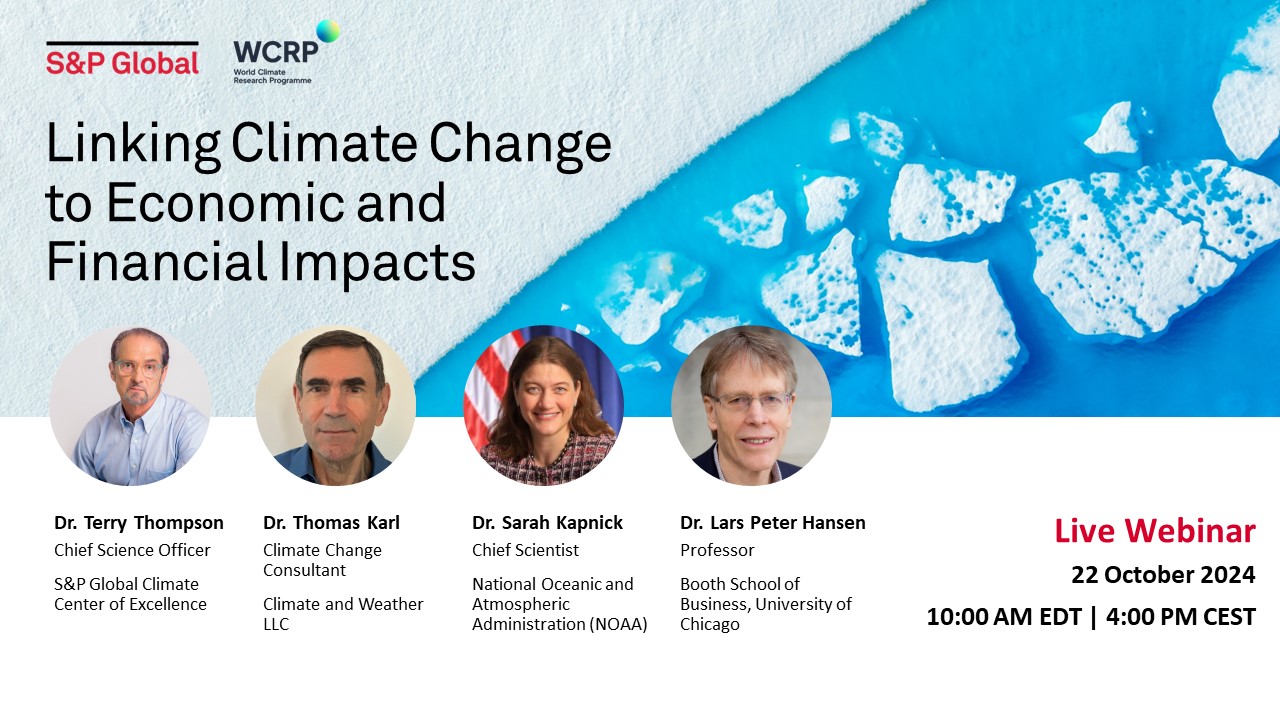
We are delighted to invite you to a webinar on "Linking Climate Change to Economic and Financial Impacts" as part of the Safe Landing Climates LHA webinars on 22 October 2024, 16:00 CEST.
Linking physical climate hazards to economic and financial impacts requires diverse disciplines including – economics, earth-systems science, and finance. Hear from globally renowned leaders who are at the frontiers of these cross-disciplinary research areas to improve our understanding of key models, data, and methods, as well as to identify gaps that need to be addressed.
- To know more about the speakers, click here.
- Click here to register for this webinar.
- Details
The World Meteorological Organization Science and Innovation Department is looking for a Department Director (Grade D2), for a 2-year period, in Geneva (Switzerland).
Responsible to the Executive Management (Secretary-General, Deputy Secretary-General and Assistant Secretary-General), the incumbent is accountable for the management of the Science and Innovation (SI) Department and ensures that the Department carries out its work as an integral part of the Secretariat and with smooth collaboration with the Departments and Regional Offices.
For more information and to apply click here.
- Details
The United Nations General Assembly adopted without a vote was a resolution titled “Decade of Action for Cryospheric Sciences, 2025–2034” (document A/78/L.99). By its terms, the Assembly proclaimed the Decade of Action for Cryospheric Sciences to address the challenges associated with melting glaciers and changes to the cryosphere by advancing related scientific research and monitoring.
Introducing that text, the representative of France, speaking also on behalf of Tajikistan, spotlighted the vulnerability of glaciers and poles to climate change and their role in regulating climate, ocean levels and preserving biodiversity. Describing the cryosphere — the frozen components of the Earth’s system — as “an essential resource for our planet’s equilibrium”, she said that more than 30 countries, with the support of United Nations Educational, Scientific and Cultural Organization (UNESCO) and the World Meteorological Organization (WMO), have launched an international appeal for the poles and glaciers, committing to launch a Decade of Cryospheric Sciences from 2025 to 2034. “This UN Decade will provide a political impetus needed to make this issue a priority on the multilateral agenda,” she said.
To read the press release, click here.
- Details
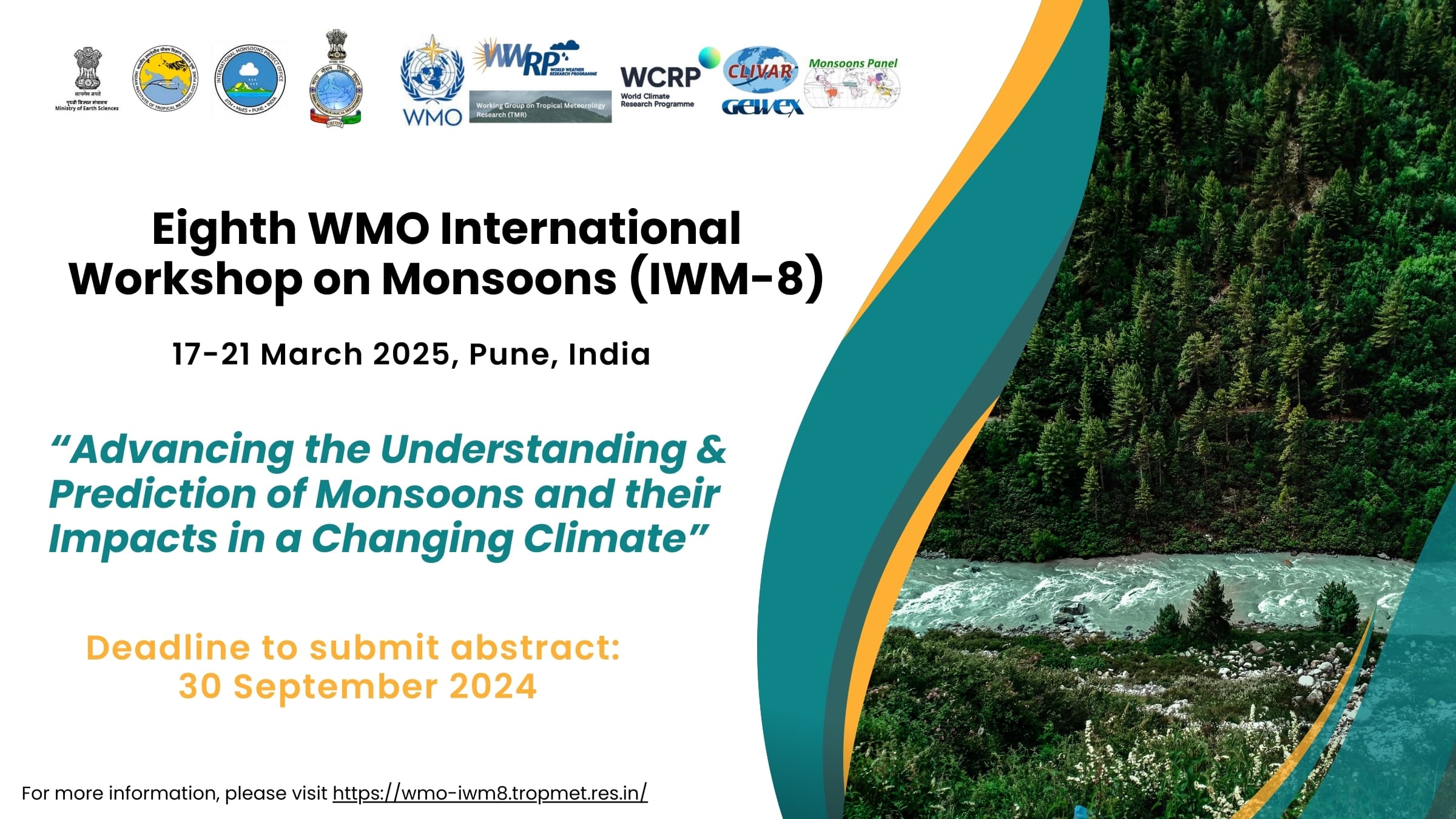
The Eighth WMO International Workshop on Monsoons (IWM-8), jointly organized by WWRP, WCRP, the Indian Institute of Tropical Meteorology (IITM), Ministry of Earth Sciences (MoES), Government of India, in cooperation with the India Meteorological Department (IMD) and the International Monsoons Project Office (IMPO), will be held at Pune, India during 17-21 March 2025, both on-site and virtually. IWM-8 will focus on Advancing the Understanding & Prediction of Monsoons and their Impacts in a Changing Climate and will emphasize on addressing monsoon impacts as part of the societal challenges prioritized by the WWRP and WCRP.
Interested people are invited to submit their abstracts online by 30 September 2024.
- For more information and abstract submission, please visit the workshop website: https://wmo-iwm8.tropmet.res.in/
- To read the first circular, click here.
Photo by Amal Abdulla from Pexels
- Details
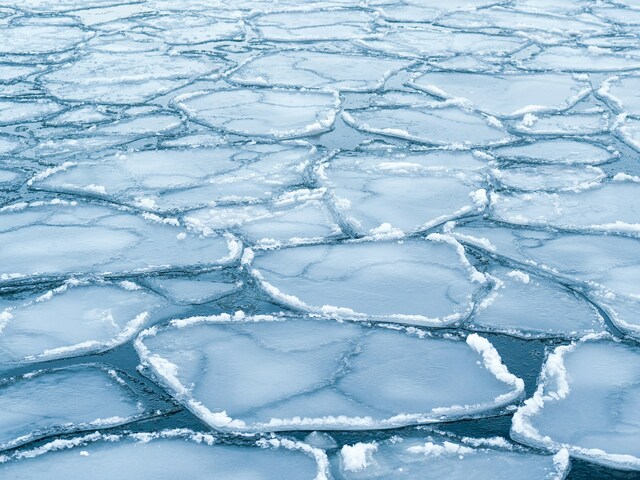
Antarctic sea ice is on track to be at extreme deficit for the second consecutive winter. In response, polar scientists are calling for urgent global action and a commitment towards the Antarctica InSync programme. The Call for Action is an outcome of the School on Polar Climates: Theoretical, Observational and Modelling Advances, which ran from 22 to 27 July at the International Centre for Theoretical Physics (ICTP), Trieste, Italy.
- Details
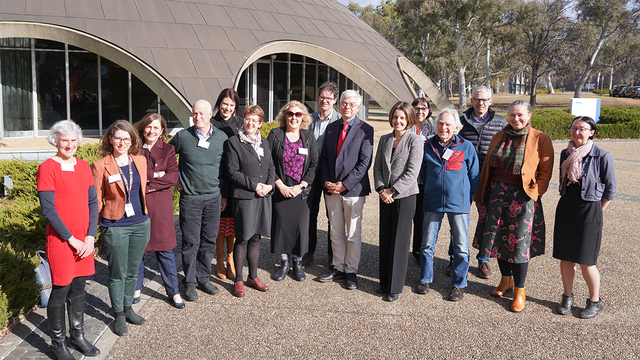 Professor Detlef Stammer, the Chair of World Climate Research Programme Joint Scientific Committee (WCRP JSC) visited Australia and New Zealand in June 2024 to present WCRP’s work and engage with the climate scientists and funders in these countries. His visit was aimed at informing the community about the developments within WCRP.
He visited the Antarctic Research Centre at the Victoria University of Wellington, New Zealand, Australian Research Council Centre of Excellence for the Weather of the 21st Century in Melbourne, Australian Antarctic Partnership Program in Hobart, University of New South Wales Climate Change Research Centre and Australian Research Council Centre of Excellence for Climate Extremes in Sydney, and Australian Academy of Science in Canberra.
His visits triggered several workshops and roundtable discussions organized by the host institutions where Detlef presented WCRP’s work including its two new lighthouse activities and the WCRP Academy to the audience. He participated in discussions around the priorities, gaps, opportunities and challenges in climate science in New Zealand, Australia and in the world, and also interacted with several early- and mid-career researchers about how to get involved in WCRP’s work.
Several action items were identified focusing on forging new or closer partnerships between WCRP, research institutes and programs in Australia and New Zealand, such as national academies of sciences. Publishing white papers around actionable climate science and climate change adaptation in New Zealand were also agreed on by the participants.
Read the full report here.
Image courtesy: Australian Academy of Science
- Details
The PCAPS project will undertake research that leads to improved service provision for vulnerable communities and those operating in the fast-changing polar regions.
To visit the website, click here.
- Details
WCRP is seeking an intern, commencing 1 September 2024 or as soon as possible thereafter for a period of 12 months, in Geneva, Switzerland. The deadline for applications is 22 August 2024. For further information and to apply, click the heading above.
- Details

- Details
The call for nominations to the CLIVAR panels and Scientific Steering Group (SSG) is now open, with appointment starting in January 2025 and January 2026 respectively. Nominations can be submitted online via the nomination form. Deadline for the submission is 18 October 2024. Detailed information about CLIVAR panels and the SSG, including current activities and membership, can be found on their respective webpages.