

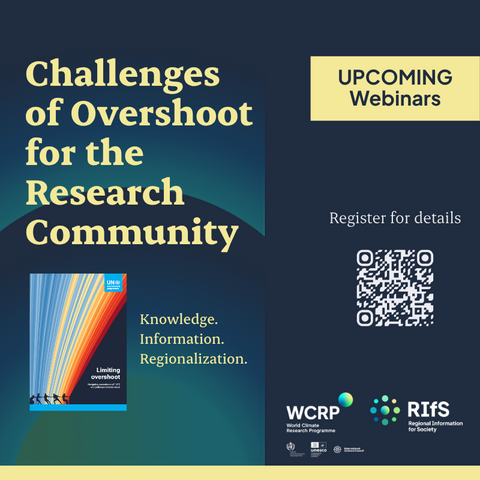
The World Climate Research Programme (WCRP) Regional Information for Society (RIfS) Core Project will convene two online fora for the climate research community, anchored by panel discussions on overshoot trajectories, consequences, mitigation, and adaptation challenges. Mark your calendar for:
- Webinar 1 – September 30, 12:30–14:00 UTC – Lived Experience: Trajectories and Consequences
- Webinar 2 – October 15, 07:30–09:00 UTC – Navigating the Return: Mitigation and Adaptation Challenges
Sign-up to receive more details as they become available here. Read UNEP’s report: https://doi.org/10.59117/20.500.11822/49857
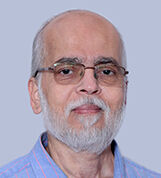
It is with great sadness that we announce the passing of our friend and colleague Professor Krishna AchutaRao. Krishna was an active member of the WCRP Joint Scientific Community, a Lead Author of the IPCC and a highly regarded member of the Indian and international science community.
To quote a long-time colleague and friend of Krishna's, Prof. Roxy Koll
"Krishna was a long-time friend and colleague, and over the years we had many conversations and arguments about climate science. What brought me closer to him was his keen scientific temper, his extraordinary attention to detail, and above all, his sense of humour. He would question an argument until he was satisfied that it stood up scientifically, but our conversations would very often leave me smiling. He was also a clear and principled critic whenever scientific temper was compromised, something that has become increasingly important in the present political climate. That combination of scientific rigour, intellectual courage and humour is something I will always remember about him."
He was widely regarded as an excellent scientist and equally remembered as a nice person. There have been a number of articles in the Indian press outlining his many contributions:
- The Indian Express: https://indianexpress.com/article/india/krishna-achutarao-iit-delhi-climate-scientist-dies-62-10865578/
- Hindustan Times: https://www.hindustantimes.com/cities/others/renowned-scientist-prof-krishna-achutarao-passes-away-at-62-101788545205719.html
- Down To Earth: https://www.downtoearth.org.in/amp/story/climate-change/major-loss-to-indian-climate-science-scientific-community-civil-society-mourn-demise-of-krishna-achutarao
He will be sorely missed by many, including those in the WCRP community.

The Regional Information for Society (RIfS) Core Project organized an expert meeting on the Robustness of Climate Change Information for Decisions in April 2024, hosted by the European Commission and co-sponsored by the Green Climate Fund.
The workshop aimed to address the following issue: When sources of climate change information do not agree or are misaligned to decision contexts, there is a lack of consensus about how to overcome this barrier and inform local-to-regional decision making.
Collectively the meeting sought to develop forward thinking on building new cross-community collaboration to advance and demonstrate the development of relevant information that is defensibly robust, aligned to context, in ways that are scalable and transferable, and thus broadly accepted and widely applicable. The meeting was explicitly designed to be a first step, a catalyst for new cross-community recognition of the challenge, and to stimulate new actions to address this. A new Interim Working Group is carrying on the work of organizing follow-on activities on these themes, including guidance and standards, global North/South partnerships, ethics and accountability, reducing epistemic uncertainties, and collaborations around responsible data use.
More information: https://www.wcrp-rifs.org/activities/workshops/

The WCRP ESMO core project is poised to embark on an ambitious new phase of Earth system modelling and observational activities, as outlined at the project's first official series of meetings at the German Climate Computing Centre (DKRZ) on 18-22 March 2024. During this first meeting, ESMO framed the future direction of the project, with an initial focus on three key aspects: better integration of observational and modelling activities, improved coordinated collaboration between different working groups and related WCRP initiatives, and the seamless incorporation of emerging topics within the existing workflow.
First, ESMO aims to bridge the gap between observational activities and Earth system modelling. This integration is crucial to produce more accurate climate projections and to understand complex climate dynamics. Prof. Susann Tegtmeier and Prof. Baylor Fox-Kemper, co-chairs of ESMO, emphasised the importance of this synergy and noted that the discussions during the meeting were instrumental in refining the project structure to better connect the observing and modelling communities. In particular, it was decided to create a new Working Group on Observations for Researching Climate, to focus on observational infrastructures, their accessibility and their integration with modelling activities and developments. A specific mandate for this working group would be to facilitate the production of data for specific communities and needs, and to be a focal point of contact for space agencies, in situ communities, industry and technology partners to communicate needs and requirements.
In relation to this last point, ESMO will particularly work to promote more coordinated collaboration among its working groups and between these groups and other related WCRP activities. Recent meetings have underlined the importance of such collaboration, with the newly formed ESMO Scientific Steering Group (ESMO SSG) identifying priorities and synergies to advance the work of each WG in an efficient manner, streamline common themes and reduce redundancies. A common set of guidelines and terms of reference, as discussed during the meeting, are currently under development to contribute to facilitating agreements and processes.
Finally, the project will intensify activities and focus on specific topics of emerging interest. Among the priorities and new pathways to improve the accuracy of climate projections, particular attention will be dedicated to measuring and monitoring carbon, energy and water cycles, improving the usability of observations in reanalysis, initialization and predictions, and promoting the sustainable integration of new technologies, including machine learning. The integration of machine learning techniques, in particular, is expected to evolve the way climate models are developed and refined, leading to more reliable and actionable climate data. A deliberate focus on new technologies is part of ESMO and WCRP's commitment to remain at the forefront of climate research and innovation.

Join us in the next webinar in the High-resolution land model and land-atmosphere coupling series of the Digital Earths lighthouse activity. Click here to register.