

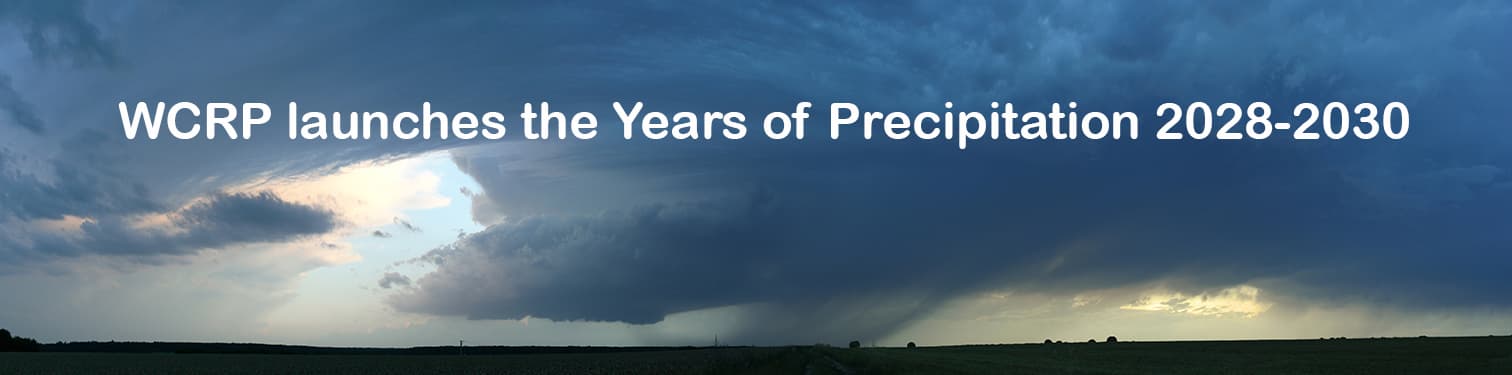
The World Climate Research Programme (WCRP), through the Global Precipitation Experiment (GPEX), is launching the Years of Precipitation (YoP), a coordinated international effort centred on 2028-2030 to advance the observation, understanding and prediction of precipitation.
Observing, modelling and predicting precipitation remain major challenges in weather and climate science. Despite significant advances in satellite observations, radar networks and numerical modelling, important uncertainties remain in measuring liquid and solid precipitation, understanding the processes that produce it, representing these processes in models, and predicting high-impact events. These challenges are particularly acute in data-sparse regions, areas with complex terrain, polar regions and over the ocean, and are compounded where resources for sustained observations and research are limited.
GPEX is addressing these challenges across four High-Impact Precipitation Systems: monsoons, tropical cyclones, mesoscale convective systems and atmospheric rivers. Its work brings together field observations, precipitation datasets and benchmarking, process understanding, modelling and prediction, and regional capacity development.
Why the Years of Precipitation?
Since its inception, GPEX has consulted with principal investigators of precipitation-related field campaigns and worked with the wider precipitation community to identify upcoming activities and engage with new efforts as they develop. GPEX subsequently identified 2028–2030 as a period when many complementary campaigns are expected to operate across different regions and precipitation systems.
YoP provides an opportunity to make greater scientific use of these investments.
Through coordinated observations, common case studies and building closer connections between field campaigns, datasets and models, GPEX aims to address scientific questions that individual activities cannot address alone. YoP will also encourage new activities where important scientific or regional gaps remain, including in high mountains, polar regions and under-observed areas, with particular attention to regions with limited observational infrastructure and research capacity.
The field campaigns are only one part of this effort. In parallel, GPEX will advance work on precipitation datasets and benchmarking, process understanding, model evaluation and prediction, and capacity development through its four Working Groups. Together, these activities provide the scientific framework for YoP.
 Examples of past, present, and future activities related to precipitation

Preparing for 2028 starts now
The Years of Precipitation will take place in 2028–2030, but preparation needs to begin well before the first coordinated observations.
During 2026–2027, GPEX will work with field-campaign teams, research programmes, National Meteorological and Hydrological Services, operational centres, space agencies, regional initiatives and funding organisations. The aim is to identify opportunities for collaboration early: aligning scientific priorities where useful, developing common case studies, strengthening links between observations and modelling, addressing regional gaps and building partnerships before campaigns begin.
This early phase is also important for ensuring that the observations and scientific advances generated through YoP have a longer-term legacy. Following the main observing period, GPEX will support coordinated data analysis and scientific synthesis, promote accessibility to precipitation datasets and, where possible, explore how relevant datasets and methods can contribute to operational services.
Who can get involved?
GPEX invites field campaigns, research programmes, observing activities, NMHSs, operational organisations, regional initiatives and funding partners to connect with YoP during its preparatory phase.
Quick links