

Upcoming Events
- AGU 2026 - A124: Years of Precipitation: Coordinating Global Efforts on High-Impact Precipitation Systems through the World Climate Research Programme’s Global Precipitation Experiment - Abstract submission deadline: August 5, 2026
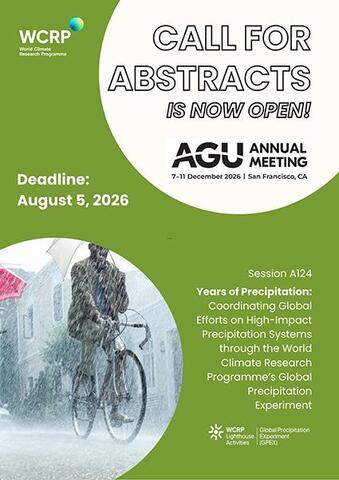 The World Climate Research Programme (WCRP), through its Global Precipitation Experiment (GPEX), has recently launched the Years of Precipitation (YoP, 2028-2030), a coordinated international effort to advance precipitation science across observations, data, and modelling. YoP will align global and regional field campaigns, strengthen datasets and benchmarking, and support process-based model evaluation across key precipitation systems with potential high impact (atmospheric rivers, monsoons, mesoscale convective systems, tropical cyclones). This session marks the launch phase of the YoP, bringing together the community to present new research and coordinated activities. We particularly invite contributions on the different aspects of precipitation, including novel observations, homogenized or targeted datasets, planned field campaigns, process understanding, model evaluation, extremes, and data-model integration, including AI/ML. Overall, the session aims to foster international collaboration, advancing precipitation prediction and supporting the development of a globally integrated precipitation research community under the YoP framework.
Past Events
Background
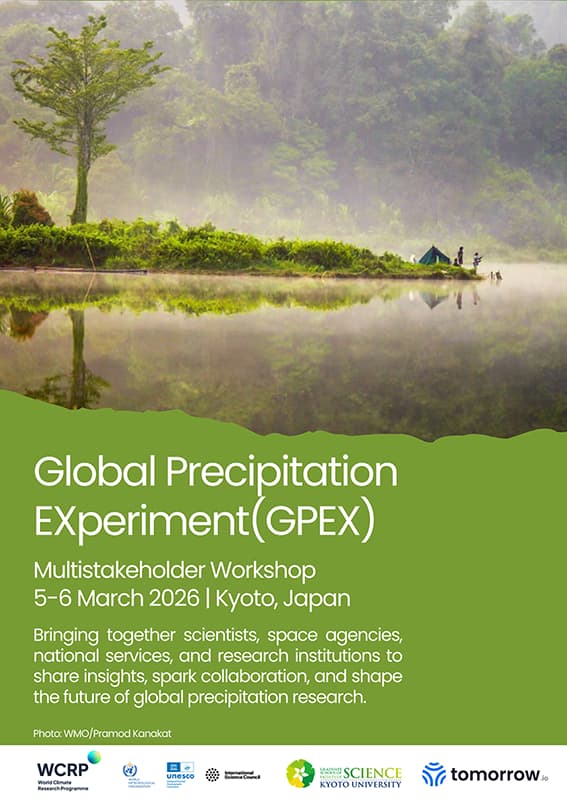
The Global Precipitation EXperiment (GPEX) is a WCRP Lighthouse Activity aiming to accelerate advances in observing, understanding, and predicting precipitation, including extremes, across regions and seasons. It integrates coordinated field campaigns, open/FAIR data development, modeling-to-application pathways, and regional/national activities with capacity development through four Working Groups (WGs):
- WG1 – Coordinated Field Campaigns (e.g., AR Recon)
- WG2 – Data Development (archives, access, QC/validation, FAIR, integration)
- WG3 – Prediction & Modeling (forecasting, km-scale ensembles, model evaluation)
- WG4 – Regional/National Activities & Capacity Development (engaging scientists, training, EMCR networks, visualization products, regional liaisons)
Purpose & Objectives of the workshop
- Showcase early findings and advances from the four GPEX Working Groups (field campaigns, data development, prediction and modeling, and regional/national activities with capacity development).
- Engage with regional and international partners – research institutions, space agencies, national meteorological and hydrological services, and operational centers focused on observations and modeling.
- Initiate collaborations across science, applications, and services to accelerate advances in precipitation research.
- Bring together planned and future field campaigns on precipitation drivers (atmospheric rivers, monsoons, mesoscale convective systems, tropical cyclones), creating synergies across regions and disciplines.
- Advance the vision of the WCRP “Years of Precipitation (YoP)” as a unifying framework for coordinated global field campaigns, enhanced data development, prediction experiments, and capacity development.
The event brought together researchers, funding agencies, practitioners, and industry representatives from across various regions for two days of intensive discussions on precipitation science and their societal relevance.
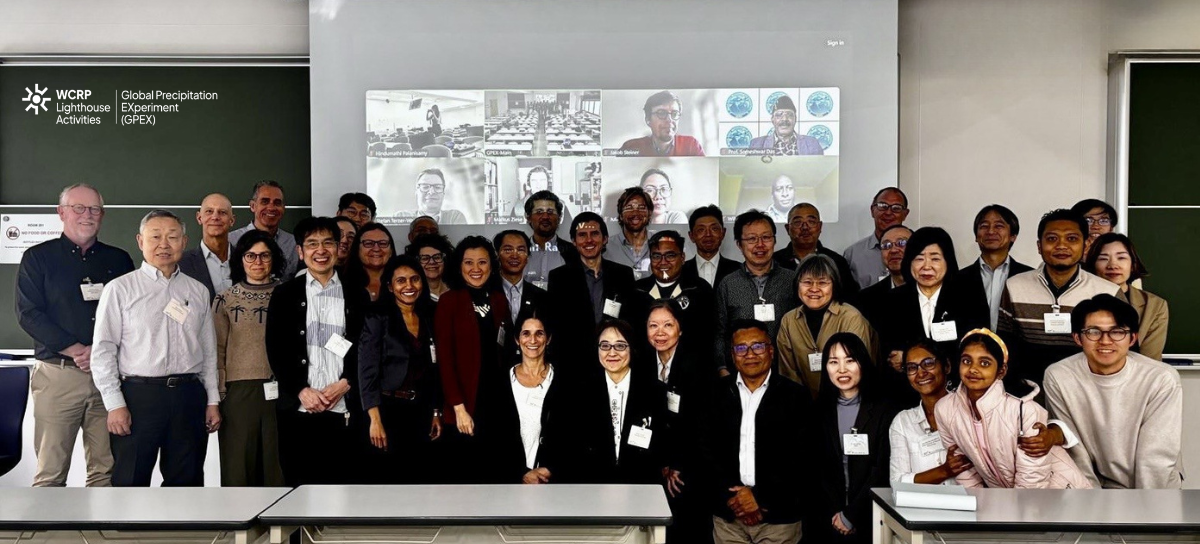
The workshop aimed to strengthen dialogue between the scientific community and key stakeholders working at the interface of climate science, operations, and services. While advances in precipitation science continue to improve our understanding of various precipitation types and related climate risks, an important challenge remains in translating complex scientific knowledge into information.
Throughout the workshop, participants exchanged perspectives on how precipitation science can better support practical decision-making and risk management. Discussions explored ways to enhance collaboration across research institutions, funding bodies, operational organizations, and partners working on climate services.
Beyond scientific exchange, the workshop also served as an important opportunity for the growing GPEX community to meet in person, build relationships, and identify potential pathways for future collaboration. Bringing together diverse actors from across various regions highlighted the importance of integrating scientific research with practical needs and regional perspectives.
The discussions in Kyoto mark an important step for the development of the GPEX initiative and help shape the next phase of its activities, strengthening collaboration between science and society in addressing precipitation-related challenges.