

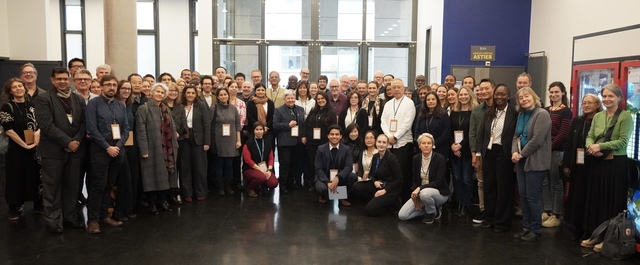
© Daniel Peyronel,
ICOM-IPSL
✨ 27 June 2026 : The workshop report is available at : https://doi.org/10.59327/WMO/WCRP/IPCC/HIETP
In late November 2025, the World Climate Research Programme (WCRP) and the Intergovernmental Panel on Climate Change (IPCC) brought together a diverse group of top scientists from around the world in Paris for a milestone workshop on Earth system high-impact events, tipping points and their consequences. Hosted by the Institut Pierre-Simon Laplace at Sorbonne Université, the meeting convened experts from across disciplines—including many authors, Bureau members of the IPCC’s Seventh Assessment Report (AR7) and members of IPCC and WCRP’s leadership—to advance shared scientific understanding of some of the most consequential risks in the climate system.
The workshop responded to growing international interest in how high impact events of poorly-known likelihood and their cascading consequences in the Earth system could affect societies and ecosystems. These topics feature more prominently than ever before, in IPCC AR7, including a new dedicated chapter in Working Group 1. With scientific knowledge in this area expanding rapidly, WCRP and the IPCC recognized a need to clarify concepts and their communication, assess emerging evidence and key questions, and identify research gaps as a foundation for future assessments. In parallel to the workshop and in preparation for AR7, WCRP has been undertaking a comprehensive scientific assessment to be published in 2026. Key findings from the zero-order draft of the assessment contributed to the outcomes in the Workshop Report. One of the central themes of the meeting was the need to sharpen definitions used to describe high-impact events and tipping points. Participants examined terms such as abrupt change, low-likelihood high impact outcomes, tipping point, and cascading impacts, with the aim of ensuring consistent usage across physical climate science, impacts and adaptation research, and mitigation in AR7.
Over the course of three days, participants considered how high-impact events—ranging from regional scale extreme climatic conditions (such as droughts and fire) to global-scale shifts (such as changes in polar ice sheet stability or ocean circulation), can propagate with consequences through natural and human systems. Discussions included new scientific findings and knowledge gaps. Participants highlighted the need for improved observations, enhanced modelling tools, and strengthened methodological approaches for understanding how risks might unfold across regions and sectors at different space and time scales. The workshop further underscored how scientific advances can support more effective communication, engagement and action with policymakers and the public. Participants emphasized the need for clear language, relatable explanations, and balanced messages that convey both urgency and agency—principles that align closely with WCRP’s mission to ensure that cutting-edge climate research is accessible, usable, and relevant for users and decision-makers.
A preliminary summary and recommendations report consolidated by the workshop’s Scientific Steering Committee were delivered directly to AR7’s First Lead Author Meeting, held the following week in Paris. The insights shared will help inform early cross-working-group collaboration in AR7 and shape how the international community assesses complex climate impacts and risks in the years ahead. Beyond AR7, the workshop strengthens the foundation for future research under WCRP, supporting a coordinated scientific effort to better understand, anticipate, and communicate high-impact events and their consequences in climate futures. A full workshop report will be available in early 2026.
Tim Naish, WCRP Chair, who co-convened the workshop with Robert Vautard, AR7 Working Group 1 Co-Chair said, “I was delighted with high level of engagement and rich information sharing by all the participants” and that he “believes that WCRP and IPCC now have a great working model for addressing other high priority policy relevant topics in climate science.” Robert Vautard noted, “that the workshop created an extremely valuable and timely platform for launching assessment of High impact events and tipping points in AR7, with a common framework across Working Groups”.